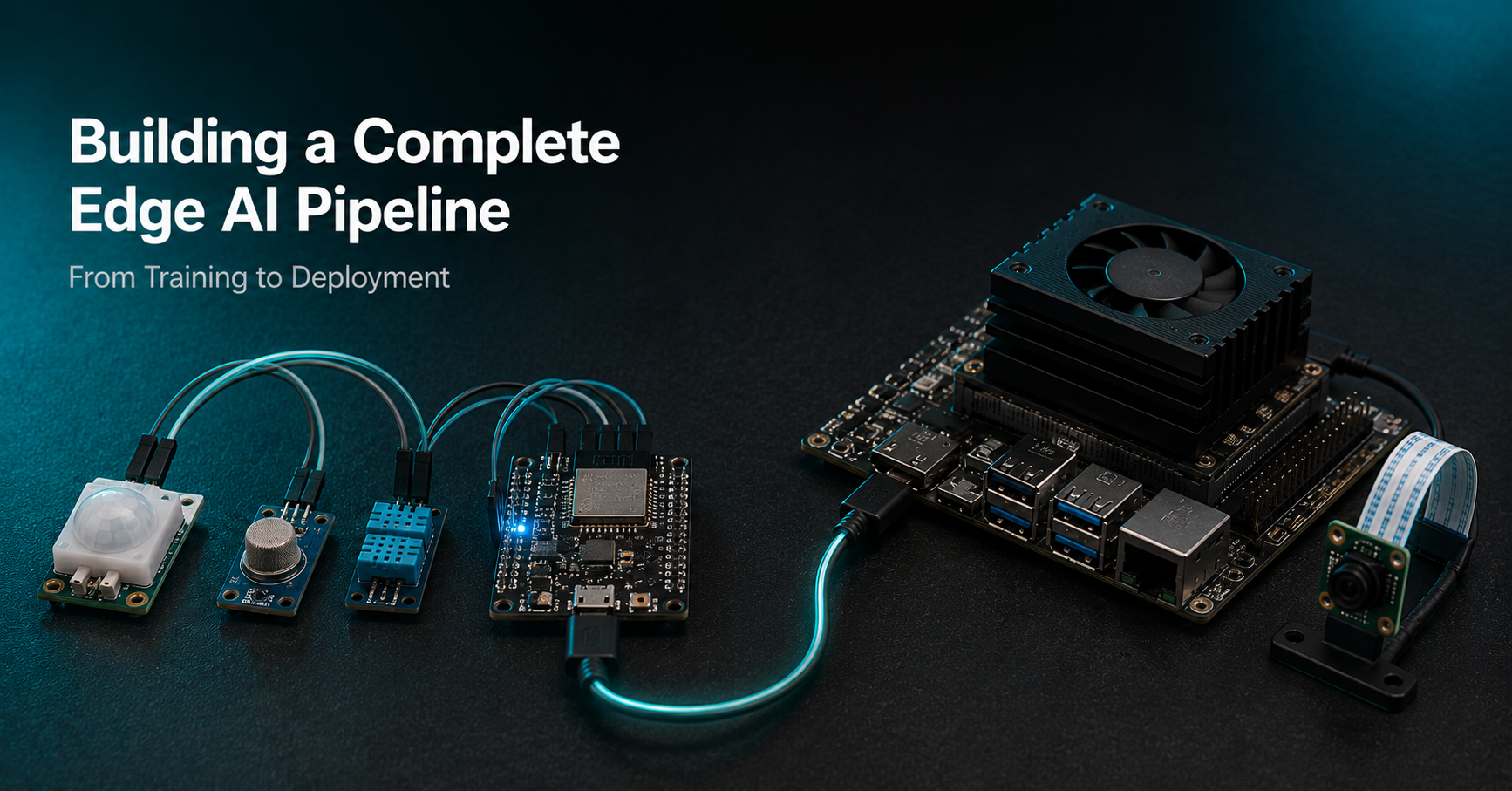
How training, fine-tuning, quantization, and embedded connectivity fit together in one system
The previous posts in this series each covered one stage of the pipeline in isolation; protocols, hardware, fine-tuning, quantization. In real projects, none of those stages exist alone; they're one continuous system, and a weak link anywhere breaks the whole product. This post walks through how to connect all of it end to end on a Jetson Orin Nano or Raspberry Pi deployment.
What Should You Define Before Writing Any Code?
Target hardware and its power/thermal budget.
Required latency and accuracy for the use case.
Connectivity available on-site: Wi-Fi, LoRa, cellular, or fully offline.
These constraints decide almost everything downstream — the base model architecture, the quantization precision, and even which microcontroller protocol handles the sensor inputs feeding the model.
How Do You Approach Data and Fine-Tuning?
Start from a pretrained, edge-friendly architecture, then fine-tune on a dataset that includes real samples from the deployment environment wherever possible.
Keep the export path in mind from the first training run, check early that the model architecture converts cleanly to ONNX, rather than discovering incompatible ops after weeks of training.
How Do You Export and Quantize the Model?
# Export
torch.onnx.export(model, dummy_input, "model.onnx", opset_version=17)
# Build a TensorRT engine (Jetson)
trtexec --onnx=model.onnx --saveEngine=model.trt --fp16
Validate accuracy at every conversion step, PyTorch to ONNX, then ONNX to TensorRT, rather than only checking the final engine. It's much faster to catch a regression right after the step that introduced it.
How Do You Wire the Model Into the Embedded System?
This is the stage that ties back to the microcontroller side of the job. A typical layout looks like this:
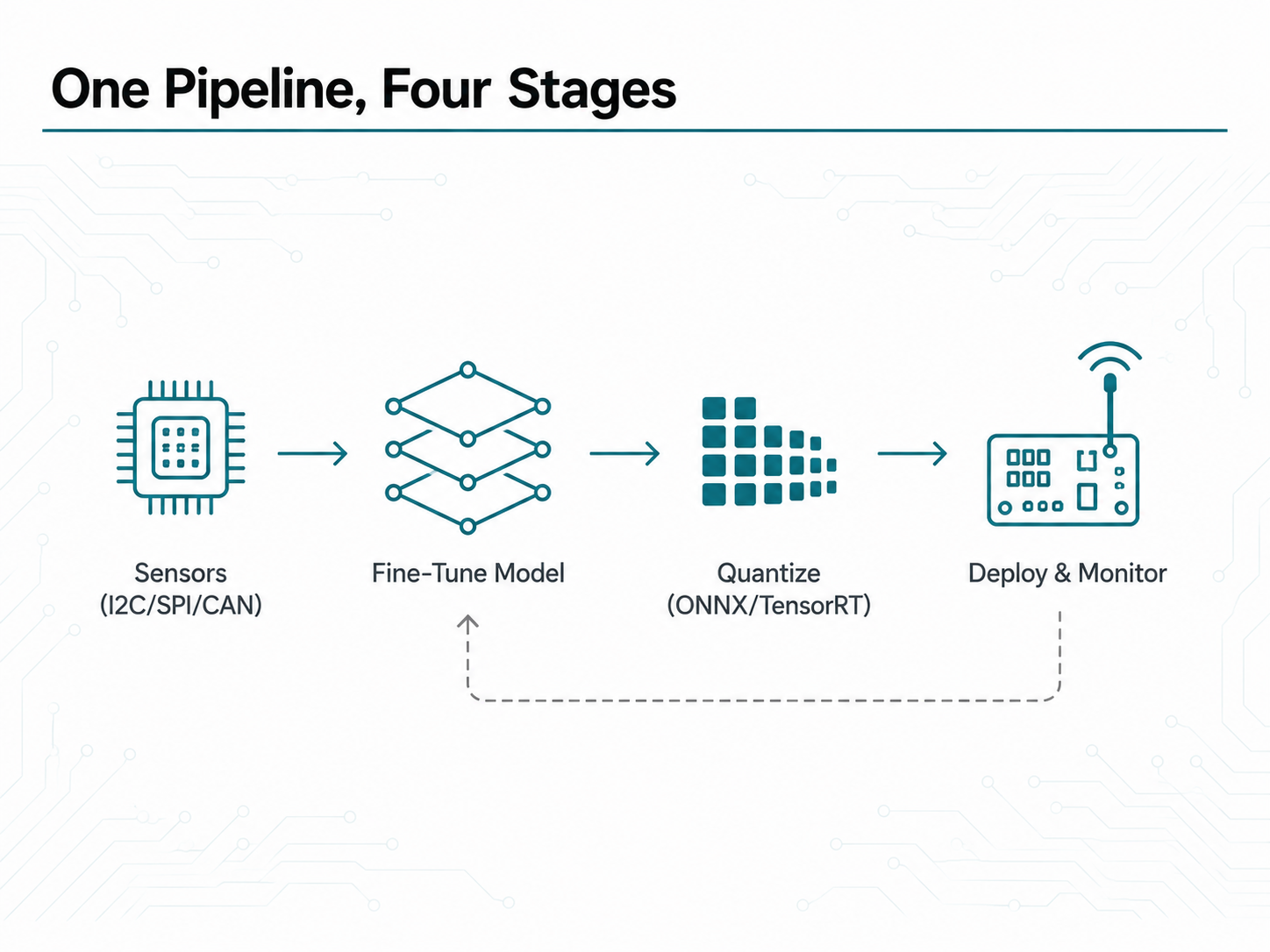
A microcontroller handles sensors and actuators over I2C/SPI, publishing readings over UART or CAN.
The Jetson or Raspberry Pi ingests that data alongside camera input, runs the quantized model, and produces an inference result.
Results get published over MQTT to a local gateway or cloud endpoint, and can also trigger the microcontroller directly for low-latency actuation.
Keeping the AI compute and the real-time control loop on separate processors — the microcontroller for hard real-time tasks, the edge AI board for inference — has consistently given more predictable behavior than trying to do both on one chip.
For hobbyists and engineering students building this kind of layered system in Pakistan, sourcing a matched set of parts locally saves real project time. CircuitHub.pk carries microcontroller boards, I2C/SPI sensor modules, CAN transceivers, and Jetson/Raspberry Pi accessories together, with nationwide shipping and cash on delivery, so a full prototype stack can arrive in one order instead of several.
How Do You Deploy and Monitor an Edge AI System?
Package the inference application as a service that restarts automatically on failure or power loss.
Log inference latency and confidence scores on-device for later review.
Support OTA updates for both the model weights and the microcontroller firmware.
Set up a lightweight way to pull field data back for the next fine-tuning cycle.
Why Should You Treat Deployment as a Loop, Not a One-Off?
Edge AI pipelines are rarely "done" after the first deployment. Field data usually surfaces edge cases the original training set didn't cover, which feeds back into Stage 2.
Treating the whole thing as a loop; deploy, collect, fine-tune, re-quantize, redeploy; has been far more effective than treating each deployment as a one-off project.
Closing Thoughts
The embedded and edge AI sides of this job aren't really separate disciplines, they're one pipeline where protocol choices, hardware selection, model training, and quantization all have to agree with each other. Getting comfortable moving across that whole stack, from a CAN bus signal to a TensorRT engine, is what makes it possible to ship something that actually works reliably outside the lab.
Ready to build your own edge AI pipeline?
Explore microcontrollers, sensors, and dev boards for every stage of your project at CircuitHub.pk with fast delivery and cash on delivery across Pakistan.