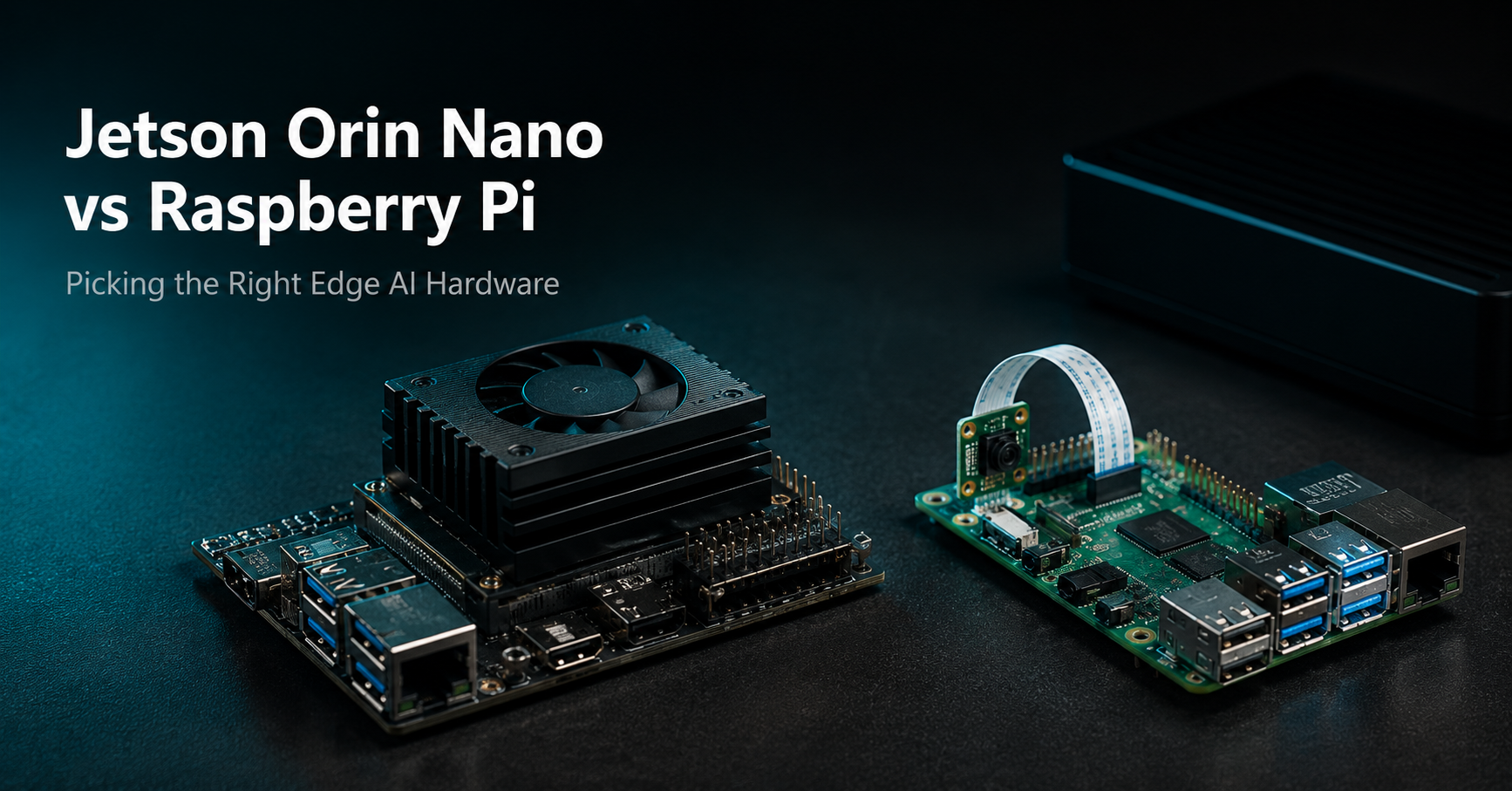
Matching silicon to your inference workload before you commit to a design
One of the first decisions on any edge AI project is the board itself. I regularly work with both boards, and the Jetson Orin Nano vs Raspberry Pi question comes up on almost every project. They solve very different problems, even though both get labeled “edge AI hardware.” This post is the comparison I wish I’d had before my first deployment.
Jetson Orin Nano vs Raspberry Pi: Compute Architecture
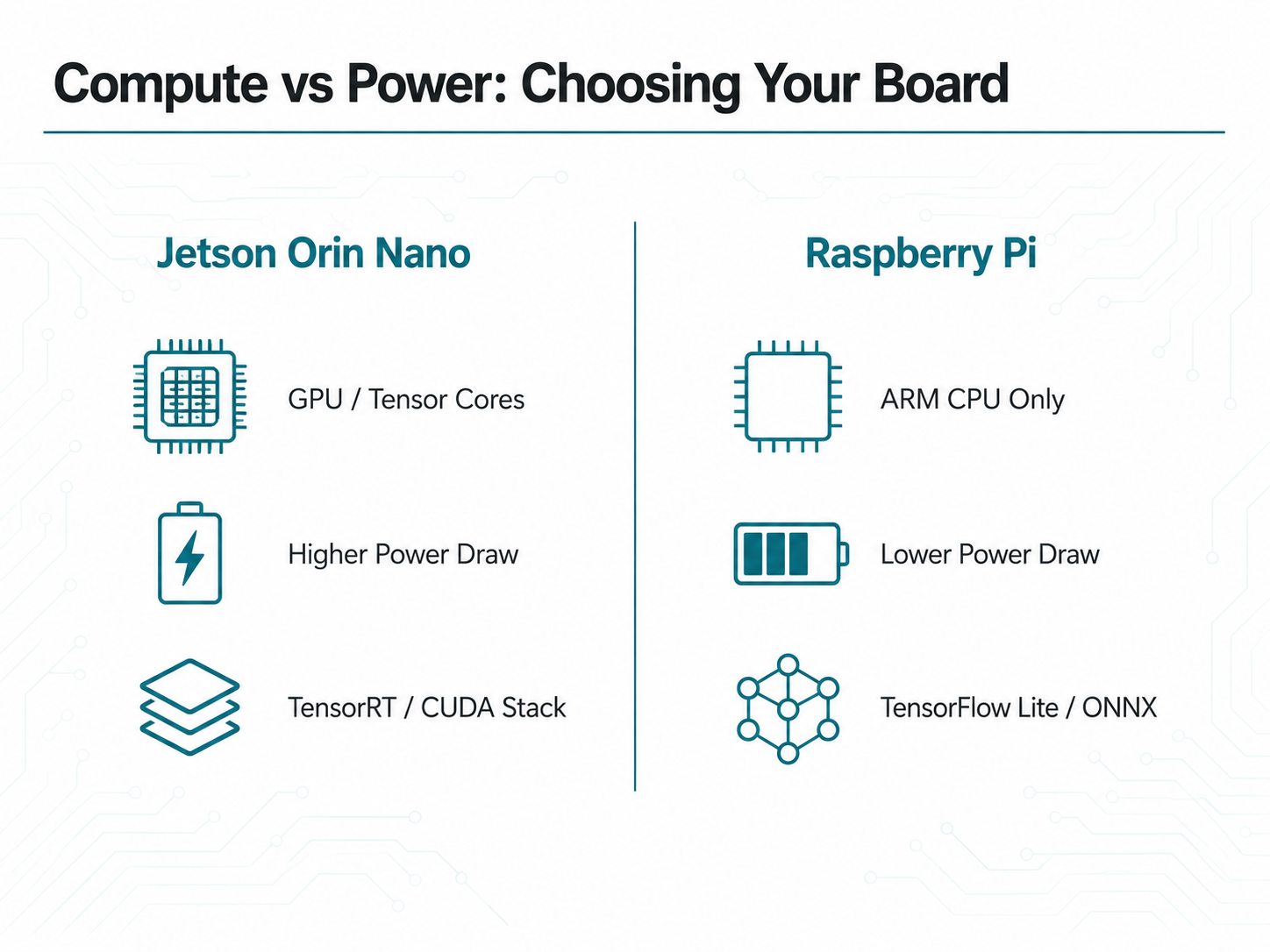
The Jetson Orin Nano is built around an NVIDIA GPU with dedicated Tensor Cores. That means it runs CUDA and TensorRT-optimized models with real parallelism.
A Raspberry Pi, by contrast, relies mainly on its ARM CPU cores. It can run AI workloads, but without a dedicated accelerator the model must be small and efficient. The alternative is pairing the Pi with an external accelerator, such as a Coral USB TPU or a Hailo M.2 module.
Raw Capability vs Practical Throughput
Jetson Orin Nano: Tens of TOPS of AI performance, with native CUDA, cuDNN, and TensorRT support.
Raspberry Pi (CPU only): Fine for lightweight classical vision or tiny quantized models. Heavier CNNs or transformers bottleneck quickly.
Raspberry Pi + accelerator: closes much of the gap for model formats the accelerator supports.
In practice, if a project involves real-time object detection, segmentation, or anything beyond a small classifier, the Orin Nano’s headroom saves a lot of optimization effort down the line.
Power and Thermal Budget
The Raspberry Pi draws noticeably less idle and average power. That matters for battery or solar-powered deployments.
The Orin Nano needs more careful thermal design, a heatsink and fan, or a well-ventilated enclosure. But its power-per-inference is often better. It finishes the same workload faster, then idles down between inferences.
Software Ecosystem
This is where the two boards diverge most for my day-to-day work.
Jetson stack: JetPack, CUDA, TensorRT, and DeepStream are purpose-built for AI pipelines. They integrate tightly with common model export tools.
Raspberry Pi ecosystem: Broader and more general-purpose. Excellent for GPIO-heavy projects, general Linux tooling, and rapid prototyping. AI tooling usually means TensorFlow Lite, ONNX Runtime, or a vendor SDK for the attached accelerator.
When Reach for Each Board:
Jetson Orin Nano: real-time camera-based inference, multiple concurrent models, and TensorRT-optimized pipelines.
Raspberry Pi: sensor fusion and control logic, lightweight always-on classifiers, and cost-sensitive high-volume deployments.
Raspberry Pi + Coral/Hailo: a middle ground when the model fits the accelerator’s supported ops and the budget can’t stretch to a Jetson.
A Quick Benchmark Habit
Before locking in hardware, run the target model on both boards with the same input pipeline. Measure end-to-end latency, not just raw inference time. Image capture, pre-processing, and post-processing often dominate the budget more than people expect:
# Jetson Orin Nano (TensorRT engine)
trtexec --loadEngine=model.trt --avgRuns=100
# Raspberry Pi (ONNX Runtime, CPU EP)
python3 benchmark.py --model model.onnx --runs 100
Final Verdict: Jetson Orin Nano vs Raspberry Pi
Neither board is objectively “better.” In the Jetson Orin Nano vs Raspberry Pi decision, the Orin Nano wins on raw AI throughput and ecosystem maturity for deep learning. The Raspberry Pi wins on cost, power, and general-purpose flexibility.
Once you’ve picked a board, the next challenge is getting a model that actually fits it. That’s where fine-tuning for edge constraints comes in — the topic of the next post.