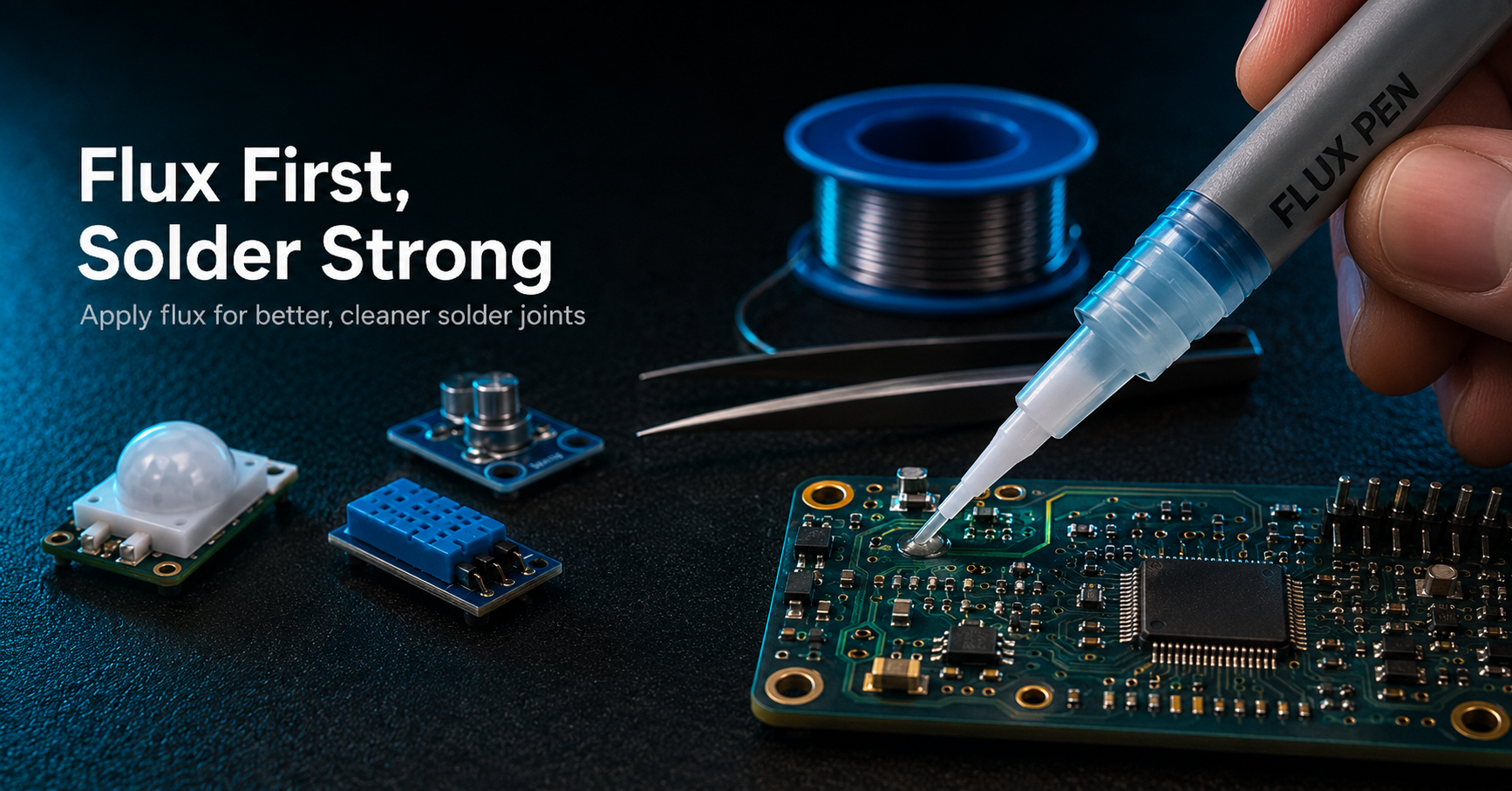
Soldering flux is a chemical compound that removes oxidation from metal surfaces, allows molten solder to wet and flow evenly, and prevents fresh oxidation while the joint is hot. Apply a thin layer to the pad or lead before soldering, then clean the residue with isopropyl alcohol unless a no-clean formulation was used.
Why Flux Is Necessary?
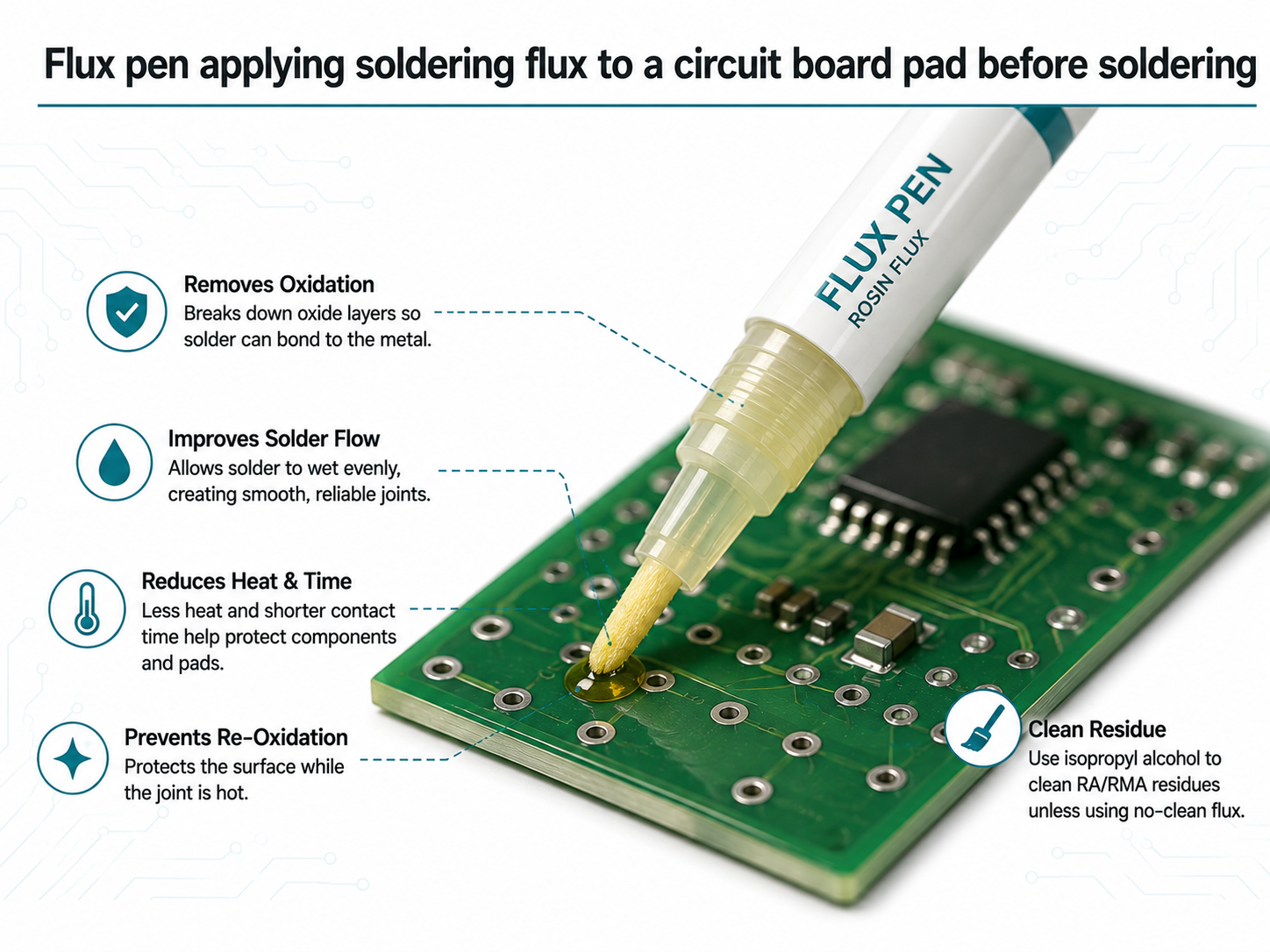
Without flux, solder beads up and refuses to adhere even to a surface that appears clean, because a microscopic oxide layer is almost always present on metal. Flux breaks that layer down and prevents it reforming during heating.
• Removes oxidation so that solder can bond to the underlying metal.
• Improves flow, producing smooth cone-shaped joints rather than dull blobs.
• Reduces the heat and dwell time required to complete a joint.
• Prevents new oxidation forming while the joint is at temperature.
• Helps solder wet evenly across pads, pins and stranded wire.
Types of Soldering Flux
Type | Character | Residue | Best suited to |
Rosin, RA | Pine-rosin based and the most aggressive at removing oxidation | Should be cleaned off | Heavily oxidised joints and repair work |
Rosin, RMA | Mildly activated and gentler on the assembly | Widely considered safe to leave, though cleaning remains good practice | General hand soldering |
No-clean | Less aggressive; formulated to leave a benign residue | Designed to be left in place | Production work on clean surfaces |
Water-soluble | Very aggressive and highly effective | Must be washed off with water shortly after soldering | Badly oxidised surfaces where washing is possible |
Flux core | Built into the solder wire itself | Minimal | Routine through-hole joints needing no extra flux |
Paste or gel | Thicker, and stays where it is placed on small pads | Depends on the formulation | Surface-mount assembly and rework |
How to Apply Flux?
1. Select the correct type. Choose rosin or no-clean for general hand soldering, and water-soluble only where the board can be washed afterwards.
2. Apply sparingly. Use a flux pen, brush or syringe to place a thin layer directly on the pad, pin or wire. A small quantity is sufficient.
3. Heat the joint normally. The flux will bubble briefly and clean the surface as the joint comes up to temperature.
4. Allow the solder to flow. With oxidation already removed, the solder should wet evenly using less heat and less time.
5. Clean the residue. Clean RA residue with isopropyl alcohol and a soft brush, and water-soluble residue with water, once the board has cooled.
Flux Problems and Their Fixes
Symptom | Likely cause | Fix |
Sticky brown or yellow film around joints | Excess flux applied, or active flux left uncleaned | Clean with isopropyl alcohol; rinse and dry water-soluble types |
False continuity between isolated points | Conductive residue bridging the measurement | Clean thoroughly, dry fully, then retest with the multimeter |
Green or white corrosion weeks later | Water-soluble or RA residue left on the board | Clean active flux immediately after soldering, without exception |
Solder still refuses to wet | Surface too oxidised for the flux used, or the joint is too cool | Move to an RA flux, clean mechanically, and verify iron temperature |
Excessive smoke during soldering | Too much flux burning off against the tip | Apply a thinner layer and use a fume extractor regardless |
Flux pen dries out or clogs | Left uncapped, or dried flux blocking the tip | Recap immediately after use and prime the tip on scrap before working |
Board surface attracts dust | No-clean residue in a handled or dusty environment | Clean with isopropyl alcohol even when using a no-clean formulation |
Poor adhesion during later rework | Contamination accumulated across repeated rework cycles | Clean the area before every rework pass, not only after the last |
Which Flux Should You Buy?
For most benches, a no-clean flux pen and a syringe of tacky paste cover the majority of work: the pen for through-hole and wire joints, the paste for surface-mount and rework where the flux must stay in place. Add an RA liquid flux only if you regularly restore corroded boards, and choose water-soluble flux only where a wash and full dry cycle is genuinely practical.
Safety Precautions
• Work in a ventilated area or use a fume extractor; flux fumes irritate the eyes, throat and lungs.
• Avoid direct skin contact with liquid flux and wash hands after handling.
• Keep flux away from open flame, as some formulations are flammable.
• Store pens and bottles capped and away from heat.
• Clean water-soluble flux promptly to prevent long-term corrosion.
Frequently Asked Questions
1. Do you need extra flux if the solder already has a flux core?
Not for routine through-hole joints, where the core provides enough. Additional flux is worthwhile for rework, surface-mount assembly, oxidised surfaces and any joint that resists wetting.
2. Must no-clean flux residue be removed?
It is formulated to be left safely in place. Cleaning is still advisable on boards that will be handled, exposed to dust, conformally coated, or subjected to sensitive high-impedance measurements.
3. Can flux residue cause a circuit to fail?
Yes. Active residue is mildly conductive and can produce false continuity readings, leakage across high-impedance nodes, and corrosion that develops over weeks or months.
Tip: when a joint will not flow after reheating, adding fresh flux resolves the problem more reliably than adding more solder.