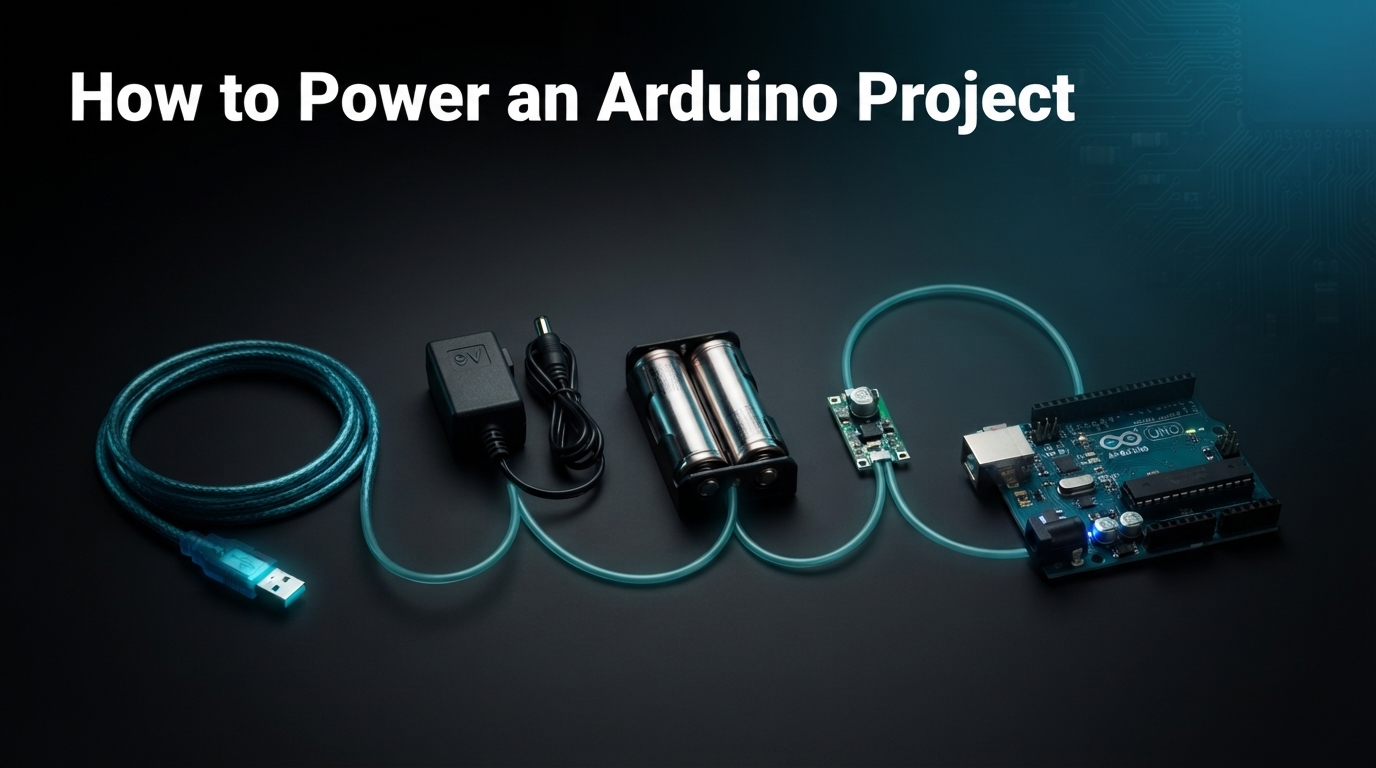
More Arduino projects fail from power than from code. The board resets every time a servo moves, sensors return random values, or the regulator gets too hot to touch. This guide explains the four ways to power an Arduino, when to use each, and the current limits that decide whether your project runs or reboots every few seconds.
The Four ways to Power an Arduino
Method | Voltage | Best for |
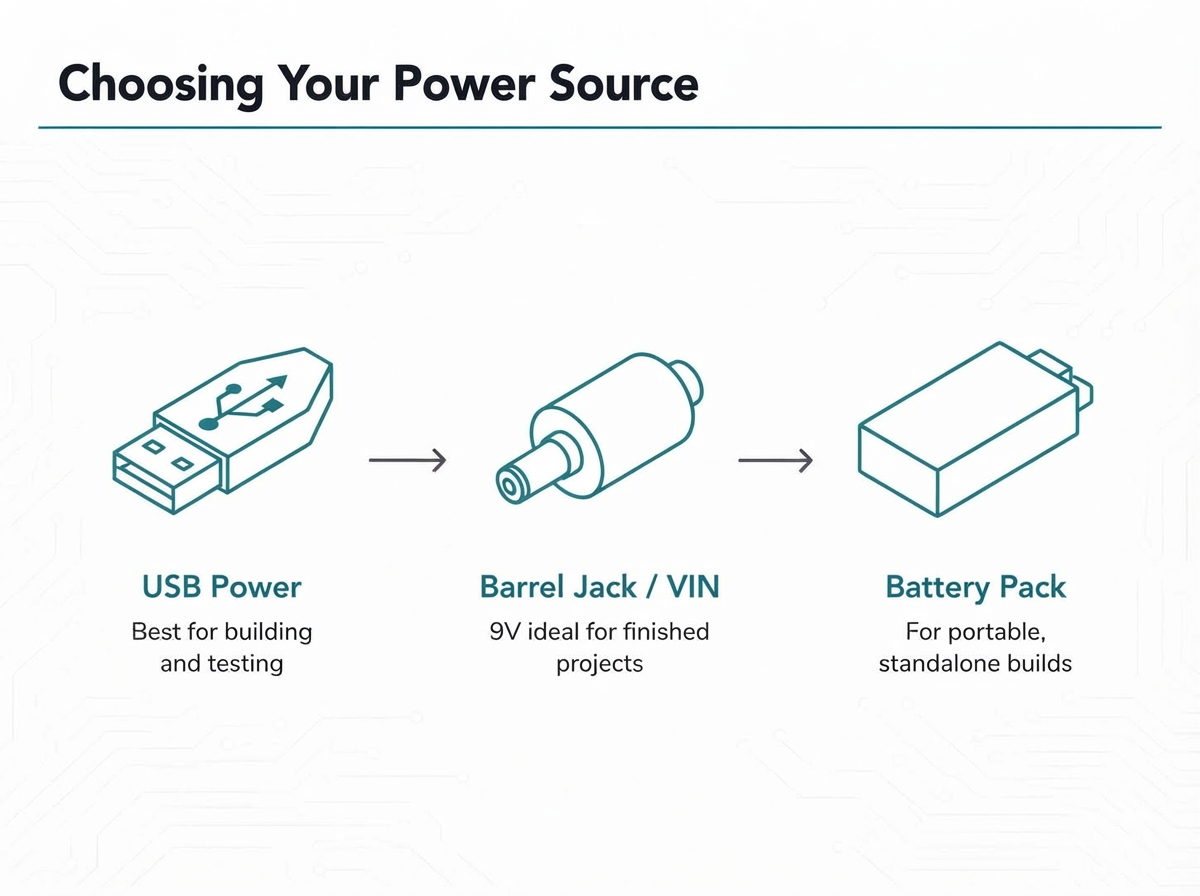
USB (PC port or 5V adapter) | 5V, about 500 mA | Building and testing; low-power projects |
DC barrel jack (Uno, Mega) | 7–12V, 9V ideal | Finished projects on mains power |
VIN pin (RAW on Pro Mini) | 7–12V | Battery packs; same regulator as the jack |
5V pin, fed directly | Exactly 5V, regulated | Buck converters and power banks; bypasses the regulator |
1. USB:
The simplest option and the right one while you are building. A PC port supplies about 500 mA, of which the board itself uses around 50 mA, enough for LEDs, sensors and an LCD, but not for motors. For a stationary finished project, a 5V 2A phone charger over USB is perfectly fine.
2. Barrel jack and VIN:
Both feed the onboard regulator, which drops the input to 5V. The higher the input, the more heat the regulator makes: at 12V it becomes uncomfortably hot above about 300 mA, so 9V is the sweet spot. Below 7V the 5V rail sags and the board starts misbehaving. On the Arduino Pro Mini the RAW pin does the same job; VCC is the regulated output.
3. The 5V pin:
Feeding the 5V pin directly bypasses the regulator entirely, so it must be a regulated 5V source, a buck converter or a power bank. Put 6V or 9V here and the board is gone. This is the most efficient option for battery projects because nothing is wasted as heat.
The current limits that matter
Any single I/O pin: 20 mA safe, 40 mA absolute maximum. That is one LED with a resistor, not a motor.
All I/O pins together: 200 mA.
The 5V pin as an output: about 500 mA over USB, up to roughly 800 mA through the jack before the regulator overheats.
The 3.3V pin: 50 mA only. It cannot power radio modules or anything else that draws a real current.
Motors, Servos and Relays
An SG90 servo draws up to 650 mA when it stalls; a DC motor draws far more at start-up. Each surge pulls the 5V rail down and the board resets, the classic “it works until the motor moves” fault.
The rule is simple: anything that moves gets its own supply, and every supply shares a ground with the Arduino. Feed an L298N motor driver from its own 6–12V input, run servos from a separate 5V 2A supply, and let a relay module switch the load from its own circuit.
Batteries for Portable Projects
9V PP3 battery: only about 500 mAh. Fine for a five-minute demo, dead within the hour on a robot.
Six AA cells (9V) into VIN: cheap, around 2,000 mAh, good for classroom robots.
Two 18650 cells in series (7.4V) into VIN: the best option for robots and long-running projects. Add a 2S protection board and charge with a 2S charger.
One 18650 with a TP4056 charger and a boost converter to 5V, into the 5V pin: the smallest package for wearables and sensor nodes.
Power bank over USB: easiest of all, but many banks switch off when the load is small. Choose one with an always-on mode.
Where to buy Power Components in Pakistan?
CircuitHub Pakistan stocks 9V adapters, 18650 cells and holders, TP4056 charging modules, buck and boost converters and the L298N motor driver alongside every Arduino board, with fast delivery in Rawalpindi and Islamabad and nationwide.
Shop Arduino power components at CircuitHub Pakistan.
Frequently Asked Questions
Can I power an Arduino with a 12V adapter?
Yes, through the barrel jack or VIN. The regulator will run warm, so keep total current under about 300 mA at 12V. A 9V adapter is the better choice.
Why does my Arduino reset when the motor starts?
The motor's start-up current pulls the 5V rail down and the board browns out. Give the motor its own supply, join the grounds, and add a 470 µF capacitor across the motor supply.
Can I use my phone charger?
Yes. Any 5V USB charger rated 1A or more works for stationary projects. Avoid chargers below 1A and cheap unbranded ones with noisy output.